Présentation des guerriers en terre cuite & Horses
Les guerriers en terre cuite & Les chevaux font partie des fouilles archéologiques les plus importantes du XXe siècle. Les travaux se poursuivent sur ce site, qui se trouve à environ 1.5 kilomètres à l'est du mausolée de l'empereur Qin Shi Huang, Comté de Lintong, Province du Shaanxi. C'est un spectacle à ne pas manquer pour tout visiteur en Chine. En montant sur le trône à l'âge de 13 (en 246 av. J.-C.), Qin Shi Huang, plus tard le premier empereur de toute la Chine, fit commencer la construction de son mausolée. Cela a pris 11 ans pour finir. On suppose que de nombreux trésors enterrés et objets sacrificiels accompagnaient l'empereur dans l'au-delà. Un groupe de paysans a découvert des poteries en creusant un puits à proximité du tombeau royal à 1974. Cela a immédiatement attiré l'attention des archéologues. Ils sont venus en masse à Xi'an pour étudier et étendre les fouilles. Ils avaient établi sans aucun doute que ces artefacts étaient associés à la dynastie Qin (211 –206 av. J.-C.). Le Conseil d'État a autorisé la construction d'un musée sur place en 1975. Une fois terminé, les gens venaient de loin pour visiter. Xi'an et le musée des guerriers en terre cuite de Qin & Les chevaux sont devenus des points de repère pour tous les voyageurs’ itinéraire. Les figurines en terre cuite grandeur nature de guerriers et de chevaux disposées en formations de bataille sont les principales attractions du musée. Ce sont des répliques de ce à quoi la garde impériale devait ressembler à l'époque de faste et de vigueur. Les guerriers en terre cuite & Les chevaux sont une découverte archéologique sensationnelle de tous les temps. Guerriers en terre cuite & Les chevaux ont mis Xi'an sur la carte pour les touristes. Guerriers en terre cuite & Les chevaux ont été inscrits par l'UNESCO en 1987 comme l'un des patrimoines culturels mondiaux.
Guerriers en Terre Cuite & Faits rapides sur les chevaux
• Nom Chinois: Bing Ma Yong 兵马俑
• Meilleure période pour visiter: Toute l'année
• Heures de visite recommandées: Environ 3 à 5 heures
• Activités à faire: Photographie, Étude du patrimoine culturel immatériel
• Heures d'ouverture: 9:00 – 16:00
• Frais d'entrée: ¥120/person
• Adresse: Lintong, 30km northeast of Xi’an, Shaanxi Province
What to expect at Terracotta Warriors & Horses
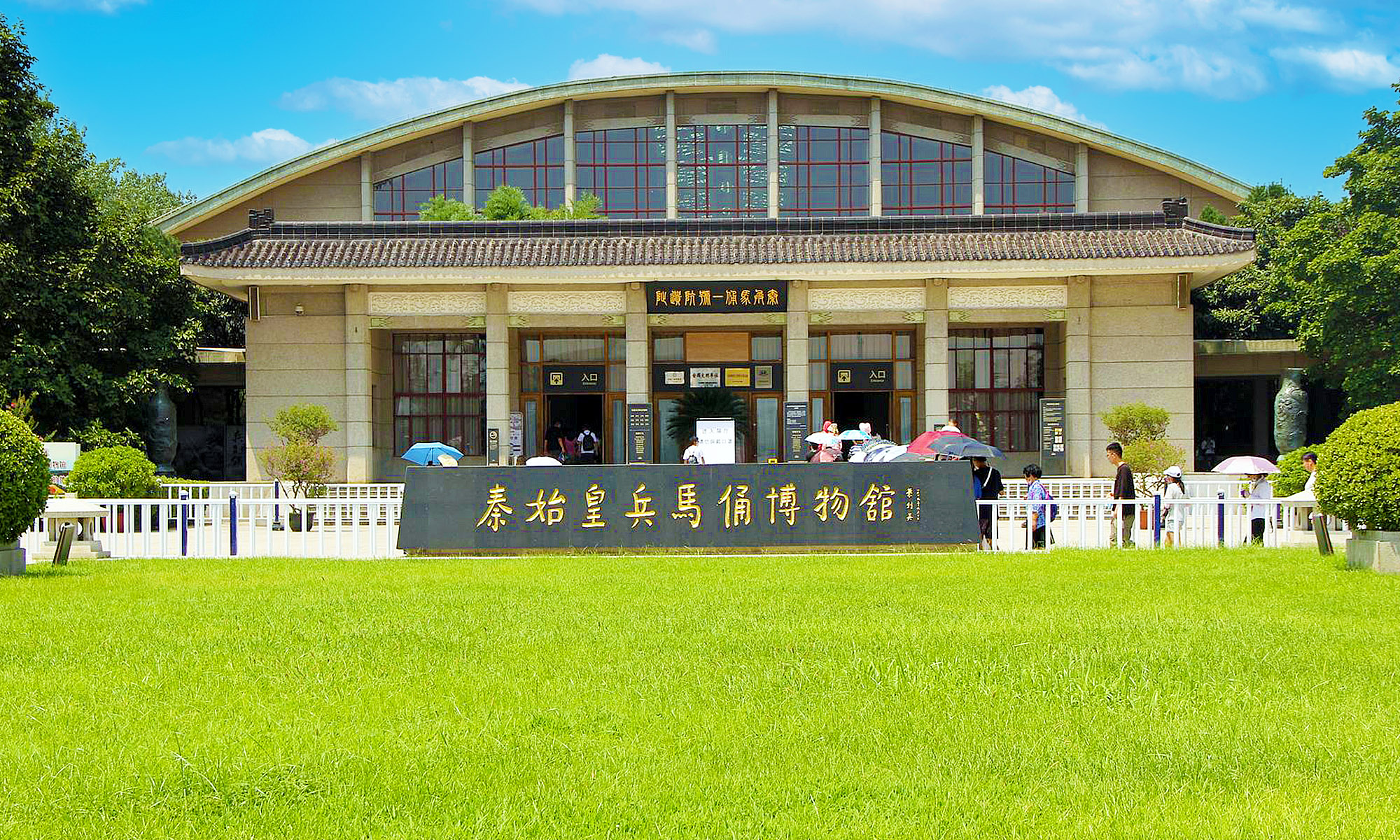
Les guerriers en terre cuite & Horses Museum covers an area of 16,300 mètres carrés, divided into four sections: No.1 Pit, No. 2 Pit, No. 3 Pit and Exhibition Hall respectively. The Pits were then named Pit 1, Pit 2, and Pit 3 by order of discovery.
Pit One
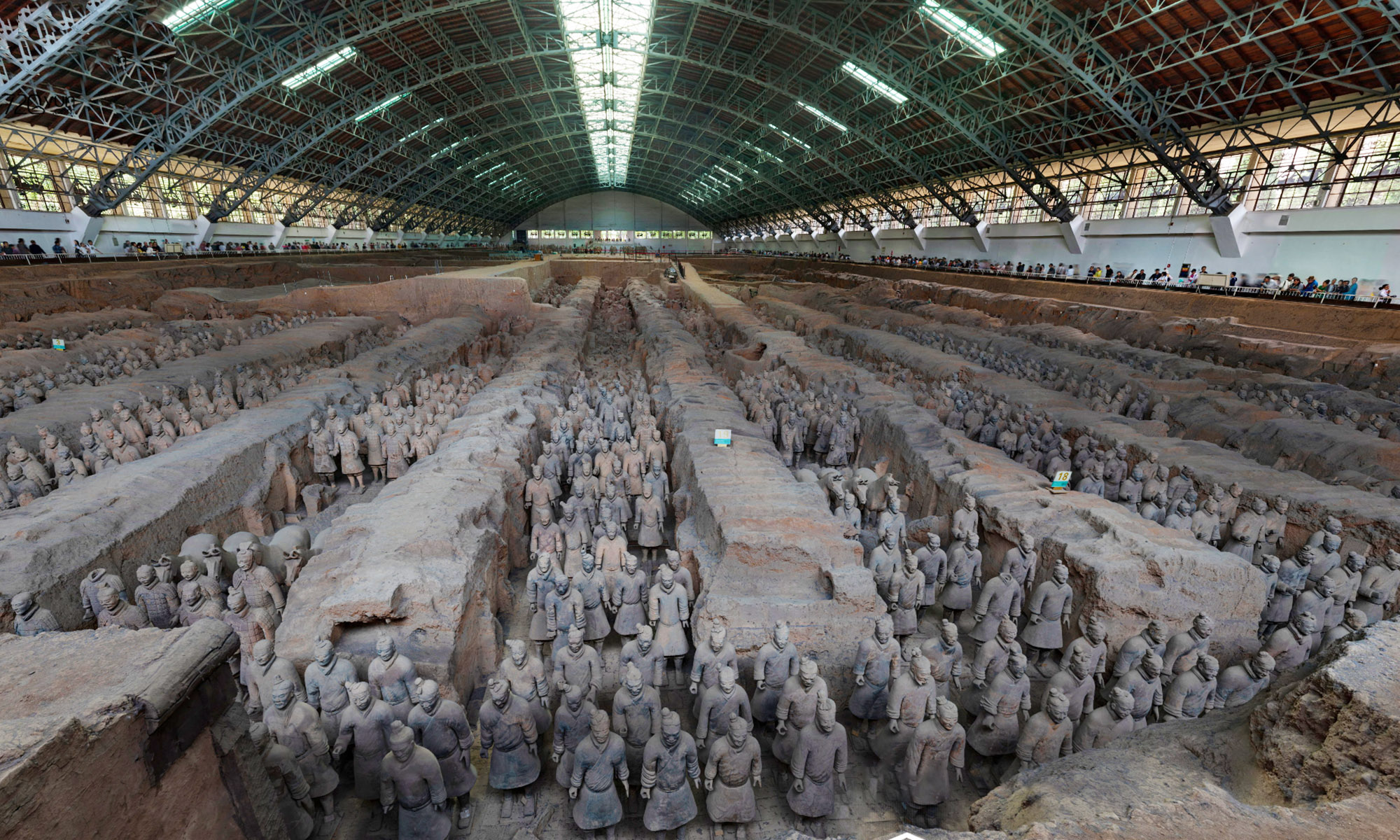
Pit 1 is the largest pit of the three pits. Pit 1 takes an oblong shape, measuring 230 meters long, 62 meters wide and 5 meters deep. The total area is 14, 260 mètres carrés, as large as two football fields. The terracotta warriors and horses in Pit 1 are arrayed in battle formation.It is assumed that there are more than 6, 000 terracotta warriors and horses in Pit 1, dont 1, 000 have been unearthed. In the long corridor to the east end of the pit stand three rows of terracotta warriors facing east in the battle robes, 70 in each row, totaling 210. Armed with bows and arrows, they constitute the vanguard. There is one row of warriors in the south, north and west of the corridor respectively, facing outward. They are probably the flanks and the rear guard. Holding crossbows and arrows and other long-distance shooting weapons, they took up the job of defending the whole army. The ten rammed partition walls divide Pit 1 into 11 latitudinal corridors where stand 38 columns of warriors facing east with horse-drawn chariots in the center. These warriors are probably the main body of the formation and represent the principal fighting force.
Pit Two
Pit 2 was found in 1976, which is 20 meters to the northeast of Pit 1. The pit is L-shaped and measured 6, 000 mètres carrés. It consists of four different mixed military forces, including infantry, charioteer, cavalry and archers. It is estimated that there are over warriors and horses, and thousands of bronze weapons inside it. The four arrays are closely connected to constitute a complete battle formation and can be divided up to act independently, capable of attacking and defending and quick response. Three of the four arrays in Pit 2 have charioteers. The chariots took up most of the battle formation. The wooden chariots have become decayed with age, but the shafts, and wheels left clear trances in the clay. The bronze parts of the chariots remain intact. It is a revelation to first discover the terracotta general, the kneeling archer and the cavalry warrior with saddle horse in the pit. There are two sloping entrances on the northern side, and four on both ends of the eastern and western sides.
Some of the figures in Pits 1 and 2 show fire damage, while remains of burnt ceiling rafters have also been found. Quand il a été brûlé et qui l'a fait n'a pas été enregistré dans l'histoire. Il existe diverses opinions sur sa destruction dans le monde académique.
Fosse Trois
Marcher 25 mètres au nord-ouest de la fosse 1, nous arriverons à P3. P3 est la plus petite des trois fosses principales et s'est avérée très différente des deux premières. Elle a la forme d'un U, totalisant environ 520 mètres carrés. Seulement 68 figurines en poterie, un char en bois tiré par quatre chevaux et 34 des armes en bronze ont été mises au jour dans cette fosse. Les guerriers dans la Fosse 1 and Pit 2 sont placés en formation de bataille. Mais ceux dans la Fosse 3 sont disposés face à face le long du mur, en deux rangées. Un seul type d'arme appelé Shu a été découvert dans la Fosse 3. Ce type d'arme n'avait pas de lame et on pense qu'il était utilisé par les gardes d'honneur. Un reste de bois de cerf et des ossements d'animaux ont également été mis au jour dans cette fosse. C'est probablement l'endroit où les offrandes sacrificielles et les prières de guerre étaient pratiquées. À en juger par l'agencement de la fosse 3, la plupart des chercheurs pensent que la fosse 3 est le quartier général dirigeant l'armée souterraine de l'Empereur.
Chariots et chevaux en bronze
Divers objets de la dynastie Qin et les modèles de chariots et chevaux en bronze sont exposés dans la Salle d’exposition des reliques historiques du Mausolée de l’Empereur Qin, à côté de la fosse des guerriers en terre cuite 2.
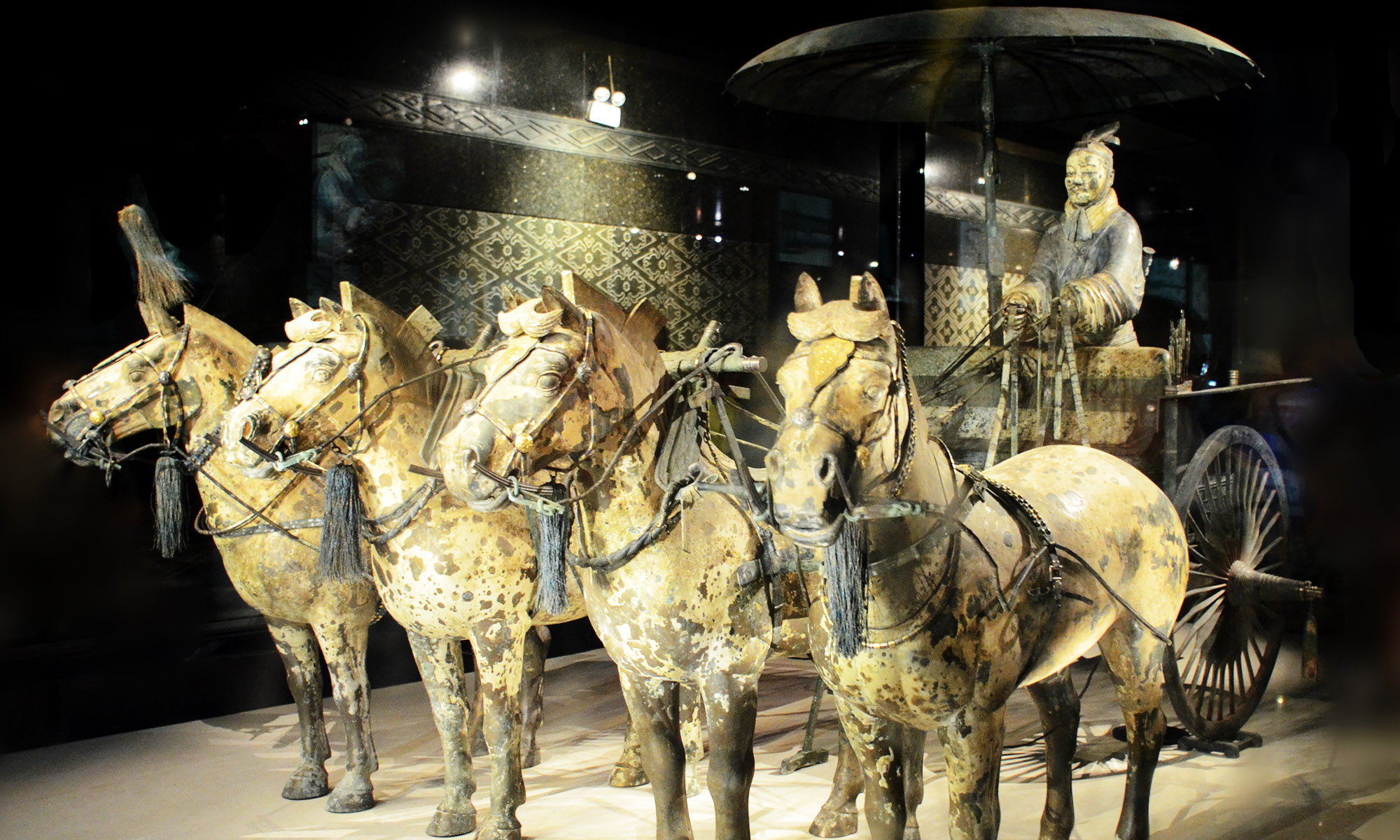
En décembre 1980, deux ensembles de grands chariots et chevaux peints en bronze ont été mis au jour 20 à quelques mètres à l’ouest du Mausolée du Premier Empereur Qin. Ils ont été étiquetés comme Chariot n°. 1 et n°. 2 respectivement dans l’ordre de leur découverte. Due to the fact that the wooden crate naturally decayed over time and the rammed soil that surrounded the pit caved in, the bronze chariots and horses had been broken into nearly 3,000 pieces when archaeologists discovered them. Fortunately, as this pit had neither been looted nor disturbed, their original positions remained intact, moreover, all parts of the chariots and horses were complete and in a condition that made them restorable. After eight years of careful and painstaking restoration, they have been restored to their original shape and now are displayed in the exhibition hall.
The two sets of bronze chariots and horses were intended to be used by the soul of the Emperor for his travels in the afterlife, so they are exact imitations of the actual ones of Emperor Qin Shihuang in half life-size. The two bronze chariots and horses represent the pinnacle of ancient Chinese metallurgical technology, and provide valuable materials and data for the research of the mechanism behind chariots of the Qin Dynasty. They are the largest, most complex and best preserved bronze wares discovered in the history of the Chinese archaeology, and have been praised as the “the top bronze works” of Ancient China.
The bronze chariots drawn by four horses, with a single shaft, were placed one before the other vertically.
No. 1 Chariot is 2.25 meters long, 1.52 mètres de hauteur, with the total weight of 1,061 kilograms. It was equipped with crossbows, arrow heads and shields. There is a large umbrella providing shade from the sun. Its handle is flexible and rotatable to block the sun from different angles. The charioteer wore a hat. This shows that it was employed to protect the No. 2 Chariot behind.
No. 2 Chariot is larger than the No.1 Chariot. Elle mesure 3.17 meters long, 1.06 mètres de hauteur, with the total weight of 1,241 kilograms. The chariot was fitted with more than 1,500 pieces of silver and gold and other ornaments, and was probably used for the Emperor Qin Shihuang’s soul to go out on inspection. The chariot has three windows, one to the front, and one on either side in the compartment, and a door opens at the back. One may open and close the windows and the door. The roof is umbrella shaped, said to be symbolic of the round sky. There is a kneeling figure driving the No. 2 bronze vehicle.
How were the terracotta warriors & horses made?
The terracotta figures are life-sized, typically ranging from 175 cm to about 200 cm. They vary in height, uniform, and hairstyle in accordance with rank. Their faces appear to be different for each individual figure. It is presumed that each warrior was made according to the real valiant Qin army soldier. They were manufactured in workshops by government laborers and local craftsmen using local materials. Heads, arms, legs, and torsos were created separately and then assembled by luting the pieces together. After the figures are readily made, they were put into kilns to be baked. After then, the clay figures were carefully painted with colors. As the figures have been burnt and gone through a natural process of decay, we can’t see their original gorgeous colors. Cependant, most of the figures bear the traces of the original colors, and a few of them are still as bright as new.
Comment se rendre aux Guerriers de Terracotta & Horses
Il n'y a pas de transport public direct pour se rendre aux Guerriers de Terracotta & Horses. Il est recommandé de louer une voiture sur GoGrandChina.com ou d'essayer les instructions suivantes:
Depuis le centre-ville de Xi'an jusqu'aux Guerriers de Terracotta
• Prenez la ligne de métro 1 jusqu'à l'arrêt terminal Fangzhicheng. Prenez le bus touristique n°5 ou 306 depuis un arrêt de bus sur le bord de la route 25-30 à quelques mètres au nord de la gare routière Fangzhicheng la plus proche, qui circule entre 7:00 and 19:00. Cela vous conduira au musée des Guerriers de Terracotta.
• En taxi: 1 heure; environ 170 ¥.
De l'aéroport international de Xi'an aux Guerriers de Terracotta
• Prenez la navette de l'aéroport jusqu'à la gare routière Fangzhicheng et changez pour la ligne de bus touristique 5 ou 306 jusqu'au musée.
• Prenez la ligne de métro 13 jusqu'à la gare ferroviaire Xi’an Nord, changez pour la ligne 4 jusqu'à Wulukou, puis changez pour la ligne 1 jusqu'à Fangzhicheng, où vous pourrez prendre la ligne de bus touristique 5 ou 306 jusqu'au musée.
• Prenez la navette de l'aéroport jusqu'à Lintong, and then take bus Lintong 101 jusqu'au musée.
• En taxi: 70 minutes; about ¥230.
From Xian North Railway Station to Terracotta Warriors
• Prenez la ligne de métro 2 to Beidajie, puis changez pour la ligne 1 jusqu'à Fangzhicheng, finally take a tourist bus line 5 ou 306 jusqu'au musée.
• By Taxi: 1 heure; about ¥160.
Additional travel advice on Terracotta Warriors & Horses
• To protect the Terracotta Warriors & Horses, please turn off the flash of your camera when you take photos.
• The admission ticket is a pass for Qin Terracotta Warriors & Horses Museum and Emperor Qin’s Mausoleum. Normally, it’s recommended to visit Terracotta Warriors first, and if you have extra time, you can take the free shuttle bus (about 2.2km) to the Mausoleum.
• The weather of Xian is very dry, drink more water and use some moisturizer to help your skin retain moisture. If you come in summer, use some sun block to protect your skin from the strong UV of Xian.