Introducing Dujiangyan Irrigation System (d'après Wikipédia)
Le Dujiangyan est un ancien système d'irrigation dans la ville de Dujiangyan. Initialement construit vers 256 avant J.-C. par l'État de Qin comme projet d'irrigation et de contrôle des inondations, il est encore utilisé aujourd'hui. L'infrastructure du système se développe sur le fleuve Min (Minjiang), le plus long affluent du Yangtsé. La région se situe dans la partie ouest de la plaine de Chengdu, entre le bassin du Sichuan et le plateau tibétain. À l'origine, le fleuve Min descendrait rapidement des montagnes Min et ralentirait brusquement après avoir atteint la plaine de Chengdu, remplissant le cours d'eau de limon, rendant ainsi les zones environnantes extrêmement sujettes aux inondations. Li Bing, alors gouverneur de Shu pour l'État de Qin, et son fils ont dirigé la construction du Dujiangyan, which harnessed the river using a new method of channeling and dividing the water rather than simply damming it. The water management scheme is still in use today to irrigate over 5,300 square kilometres (2,000 sq mi) of land in the region.
Dujiangyan Irrigation System Fast Facts
• Nom Chinois: Du Jiang Yan 都江堰
• Meilleure période pour visiter: D'avril à octobre
• Heures de visite recommandées: Environ 2 à 3 heures
• Activités à faire: Photographie, l'histoire & culture
• Heures d'ouverture: 08:30-18:00 d'avril à octobre, 08:00-17:30 de novembre à mars
• Frais d'entrée: ¥80
• Adresse: Gongyuan Road, Dujiangyan, Province du Sichuan
UNESCO says of Dujiangyan Irrigation System
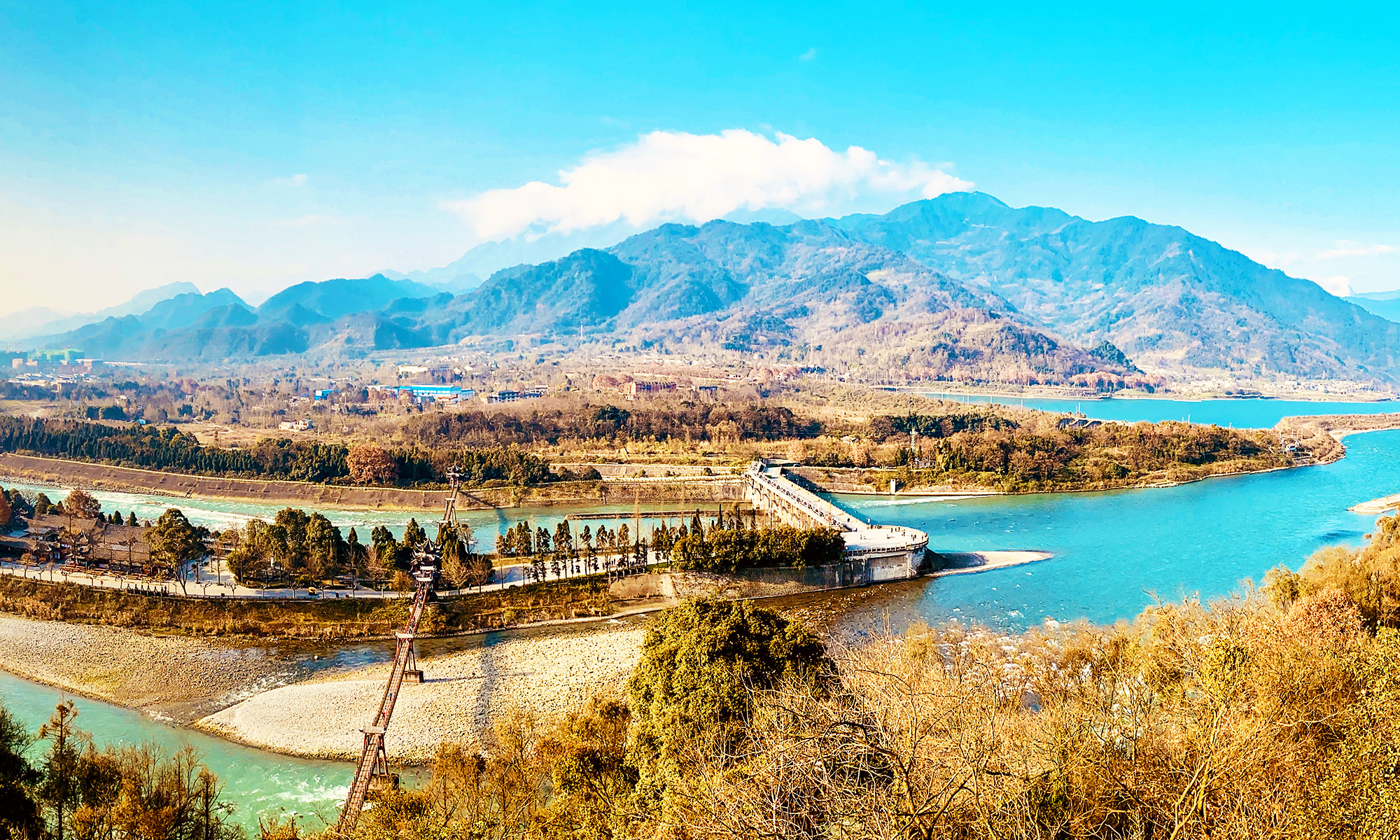
The Dujiangyan irrigation system, located in the western portion of the Chengdu flatlands at the junction between the Sichuan basin and the Qinghai-Tibet plateau, is an ecological engineering feat originally constructed around 256 av. J.-C.. Modified and enlarged during the Tang, Song, Yuan and Ming dynasties, it uses natural topographic and hydrological features to solve problems of diverting water for irrigation, draining sediment, la lutte contre les inondations, and flow control without the use of dams. Today the system comprises two parts: the Weir Works, located at an altitude of 726m, the highest point of the Chengdu plain 1km from Dujiangyan City, and the irrigated area. Three key components of the Weir Works control the water from the upper valley of the Minjiang River: the Yuzui Bypass Dike, the Feishayan Floodgate, and the Baopingkou Diversion Passage. Together with ancillary embankments and watercourses including the Baizhang Dike, the Erwang Temple Watercourse and the V-Shaped Dike, these structures ensure a regular supply of water to the Chengdu plains. The system has produced comprehensive benefits in flood control, irrigation, water transport and general water consumption. Begun over 2,250 il y a des années,, it now irrigates 668,700 hectares of farmland.
What to expect at Dujiangyan Irrigation System
Dujiangyan Irrigation System was built under the leadership of Li Bing, Governor of Shu Prefecturein the Qin State, to control the flood of the Minjiang River in 256BC. The project uses the way of “water diversion without a dam” and mainly comprises Fish Mouth Levee, Feisha Weir Spillway and Baopingkou. It takes advantage of the natural terrain at mountain pass of the Minjiang River and flow rules of the bend, and integrates three main works into a whole, thus to effectively solve problems of diversion irrigation, flood discharge and sediment ejection, form a scientific and integrate automatic irrigation and drainage system, inoculate the “Land of Abundance” Chengdu Plain.
Baopingkou
Baopingkou (also named Bottle-Neck Channel) is a gap cut on the long ridge of JianshanMountain (now called Guankou Mountain and Yulei Mountain) toward the Minjiang River, and also an artificial throat to control the water inflow of the InnerRiver. It is named after its shape like a bottle neck with amazing function. The hill on the right side of Baopingkou, separating from its mountain body, is called Lidui. The width and bottom height of Baopinkou are strictly controlled; the ancient people carved dozens of division lines on the palisades, which was named “Water Rule”, the earliest water gauge of China.
Fish Mouth
Dujiang Weir comprises Fish Mouth, Feisha Weir and Baopingkou. Fish Mouth, as a diversion dam built in the middle of river, separates the turbulent Minjiang River into Outer River and Inner River, which are used for flood discharge and diversion irrigation respectively. Feisha Weir plays a great role in discharging flood, enlever le sable et moduler le flux d'eau. Baopinkou contrôle le débit d'entrée et tire son nom de sa forme d'étranglement. Il fonctionne encore aujourd'hui, c'est pourquoi il est appelé “Musée de la Conservation de l'Eau Vive”.
Comment se rendre au Système d'Irrigation de Dujiangyan
• Le Système d'Irrigation de Dujiangyan se trouve à environ 60 km de Chengdu.
• Un train à grande vitesse relie Chengdu à Dujiangyan.
• Prenez un bus depuis la gare routière Ximen de Chengdu jusqu'à la ville de Dujiangyang. Puis prenez le bus n°. 1 ou 4 jusqu'à la zone touristique de Dujiangyan.
• Louez une voiture/bus depuis GGC pour profiter d'un transfert privé et sans souci depuis les hôtels de Chengdu jusqu'au Système d'Irrigation de Dujiangyan.
Conseils supplémentaires pour le voyage au Système d'Irrigation de Dujiangyan
• Veuillez porter des chaussures et des vêtements de randonnée confortables.
• Il pleut souvent dans la région de Dujiangyan. Veuillez préparer un parapluie ou un imperméable avec vous.
• Des vêtements à manches longues sont nécessaires pour éviter les piqûres de moustiques ou prévoyez un répulsif contre les moustiques.
• Faites attention en vous amusant près de l'eau.