Introducing Dunhuang Mogao Caves (d'après Wikipédia)
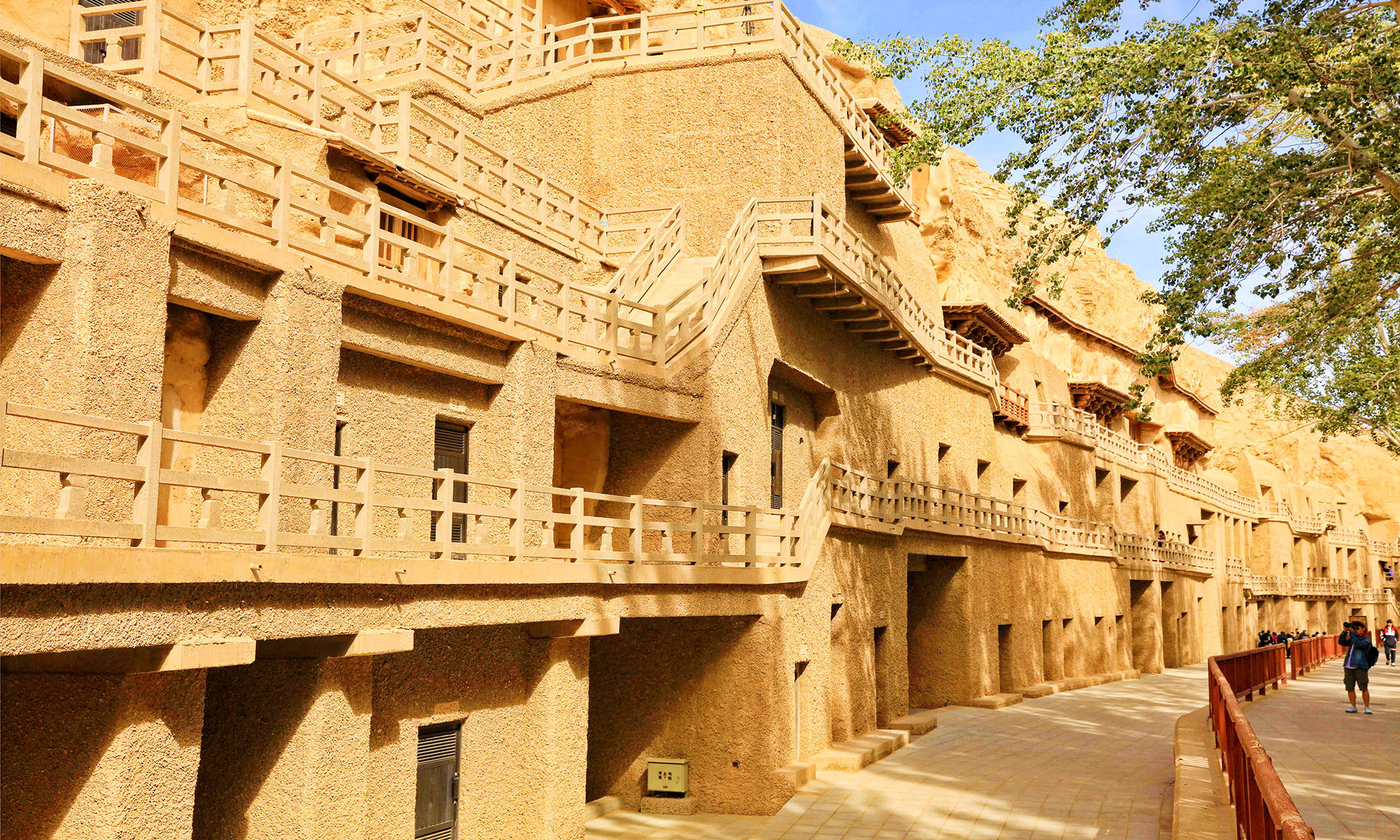
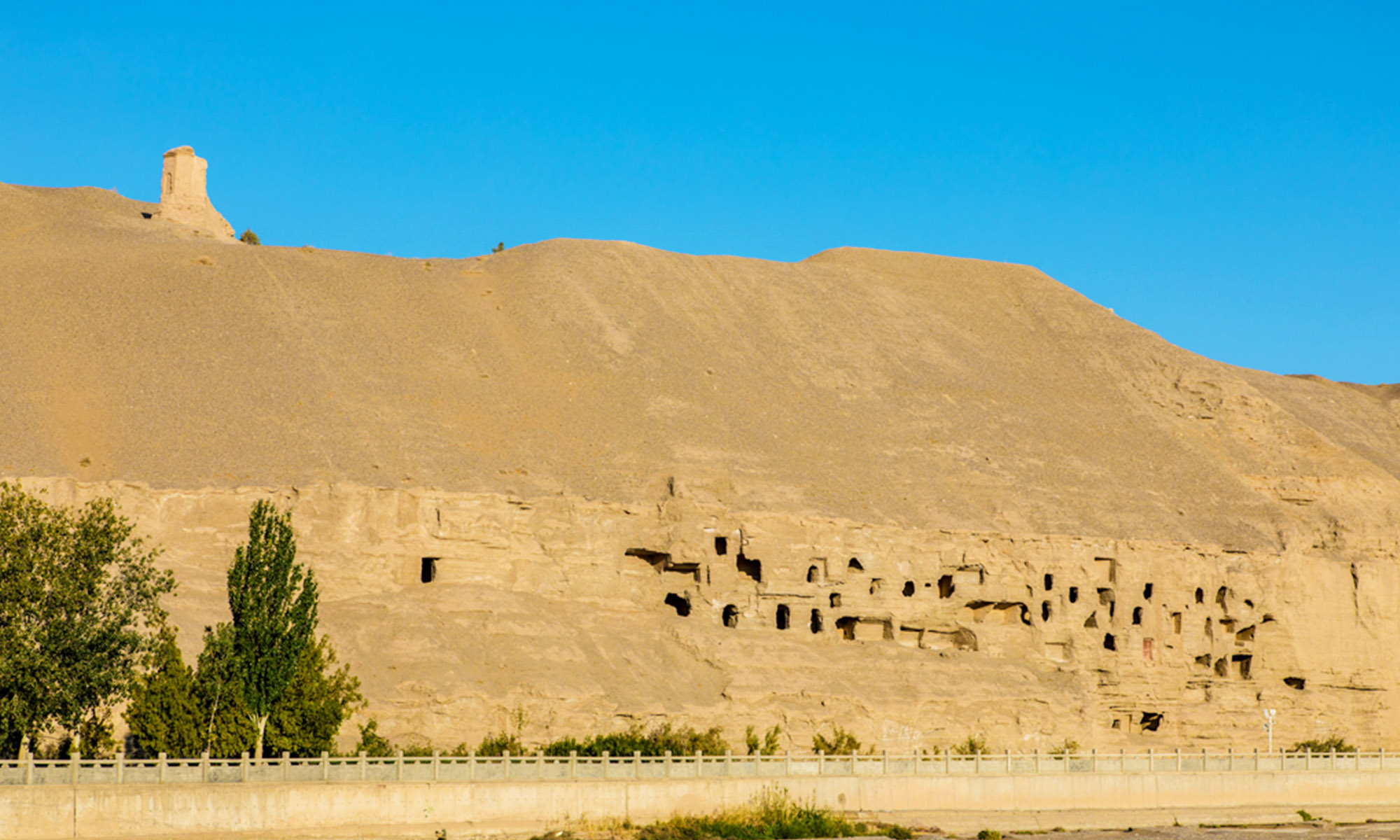
Les grottes de Mogao, également connus sous le nom de Grottes des Mille Bouddhas ou Cavernes des Mille Bouddhas, forment un système de 500 temples 25 km (16 km) au sud-est du centre de Dunhuang, une oasis située à un carrefour religieux et culturel sur la Route de la Soie. Les grottes contiennent certains des plus beaux exemples d'art bouddhiste couvrant une période de 1,000 ans. Les premières grottes ont été creusées en l'an 366 comme lieux de méditation et de culte bouddhistes. Les Grottes de Mogao sont les plus connues des grottes bouddhistes chinoises et, avec les Grottes de Longmen et les Grottes de Yungang, sont l'un des trois célèbres sites de sculpture bouddhiste ancienne de Chine. Un important trésor de documents a été découvert en 1900 dans la soi-disant “Cave de la Bibliothèque”, qui avait été murée au XIe siècle. Le contenu de la bibliothèque a ensuite été dispersé à travers le monde, et les plus grandes collections se trouvent désormais à Pékin, Londres, Paris et Berlin, et le Projet International de Dunhuang existe pour coordonner et rassembler les travaux universitaires sur les manuscrits de Dunhuang et autres matériaux.
Faits rapides sur les Grottes de Mogao de Dunhuang
• Nom Chinois: Mo Gao Ku 莫高窟
• Meilleure période pour visiter: April, Mai, juin, septembre & October
• Heures de visite recommandées: Environ 4 à 6 heures
• Type: Site du patrimoine mondial, Bouddhisme, Sculptures, Grottes
• Heures d'ouverture: 08:00-18:00 d’avril à novembre; 09:00-17:30 de décembre à mars
• Frais d'entrée: 238 CNY d'avril à novembre; 140 CNY de décembre à mars
• Adresse: Ville de Mogao, Dunhuang, Province de Gansu
Ce que l'UNESCO dit des Grottes de Mogao de Dunhuang
Creusées dans les falaises au-dessus de la rivière Dachuan, les Grottes de Mogao au sud-est de l'oasis de Dunhuang, Province de Gansu, comprennent le plus grand, le plus richement doté, et le plus longtemps utilisé trésor de l'art bouddhiste au monde. Il a été construit pour la première fois en 366 apr. J.-C. et représente la grande réalisation de l'art bouddhiste du 4ème au 14ème siècle. 492 les grottes sont actuellement préservées, abritant environ 45,000 mètres carrés de fresques et plus de 2,000 sculptures peintes. Grotte 302 of the Sui dynasty contains one of the oldest and most vivid scenes of cultural exchanges along the Silk Road, depicting a camel pulling a cart typical of trade missions of that period. Grottes 23 et 156 of the Tang dynasty show workers in the fields and a line of warriors respectively and in the Song dynasty Cave 61, the celebrated landscape of Mount Wutai is an early example of artistic Chinese cartography, where nothing has been left out – mountains, rivières, cities, temples, roads and caravans are all depicted. As evidence of the evolution of Buddhist art in the northwest region of China, the Mogao Caves are of unmatched historical value. These works provide an abundance of vivid materials depicting various aspects of medieval politics, economics, culture, arts, la religion, ethnic relations, and daily dress in western China. Le style artistique unique de l'art de Dunhuang n'est pas seulement la fusion de la tradition artistique chinoise Han et des styles assimilés des coutumes anciennes indiennes et gandhariennes, mais aussi une intégration des arts des Turcs, des anciens Tibétains et d'autres minorités ethniques chinoises. Beaucoup de ces chefs-d'œuvre sont des créations d'un talent esthétique inégalé. La découverte de la Grotte de la Bibliothèque aux Grottes de Mogao à 1990, ainsi que les dizaines de milliers de manuscrits et de reliques qu'elle contenait, a été saluée comme la plus grande découverte mondiale de la culture orientale ancienne. Ce patrimoine important fournit une référence inestimable pour étudier l'histoire complexe de la Chine ancienne et de l'Asie centrale.
À quoi s'attendre aux Grottes de Mogao de Dunhuang
Les Grottes de Mogao s'étendent sur une distance de 1.6 km (0.99 miles) du nord au sud, and contain as many as 492 known cells and cave sanctuaries. Within these, plus de 2000 painted sculptures and about 45,000 mètres carrés (484375.97 sq. ft.) of murals can be found. Plus de 50,000 manuscripts, written or painted between the 4th and the 12th centuries, were found in the Library Cave in 1900.
The Library Cave and its Museum (from DunhuangAcademy)
Dans 1900, a Daoist priest Wang Yuan-lu (1849-1931), who self-appointed himself guardian of the cave-temples in Dunhuang, accidentally discovered a sealed up cave (present-day Cave 17, known as the Library Cave) containing a huge priceless treasure of more than 50,000 manuscripts. Most of these manuscripts dated between the 4th and the 11th centuries are Buddhist, as well as Daoist, Manichean and Nestorian Christians. The manuscripts, on paper, soie, wood and other materials, are paintings, printings, and writings in many languages, including Sanskrit, le tibétain, Tangut, Uyghur, Khotanese, Kuchean, Sogdian, Mongolian and even Hebrew in addition to Chinese. The contents cover religion, l'histoire, littérature, astronomy, astrology, and private or official correspondence. During the tumultuous years between the late 19th and the early 20th century in China, thousands of cultural artifacts were carried off by foreigners. Long before the Dunhuang treasure was found, this “international race” for treasure had already started. In Dunhuang, Wang was deceived and bribed by the foreign archaeologists to give away the priceless manuscripts, paintings and statues for a small “donation”. The Hungarian-British Aurel Stein (1862-1943) is unquestionably the most villainous of the archaeologists, followed by Paul Pelliot (1878-1945) of France, and Albert von Le Coq (1860-1930) of Germany, Langdon Warner (1881-1955) of the USA, Sergei Oldenberg (1863-1934) of Russia, and Otani Kozui (1876-1948) and Zuicho Tachibana of Japan. Other than the manuscripts, Oldenberg also removed 16 murals and 61 fragments from the caves. Warner even used a special chemical solution for detaching the wall-paintings to remove several pieces of murals, and a three foot Tang statue of kneeling Bodhisattva. In his word it was a “rescue” which was and is still the most popular euphemism for plundering Otani Kozui and/or smuggling in most of these nefarious enterprises. Fortunately he was stopped by the local people on his second trip planning to “rescue” more. After the involvement of the Chinese government, the caves with their magnificent murals and polychromed statues have been saved; however considerable archaeological artifacts had already been removed from China. The collections now are scattered throughout museums and institutes, ou entre les mains de collectionneurs privés dans différents pays. Une très petite partie seulement des manuscrits trouvés dans la Grotte de la Bibliothèque reste en Chine. En face de la Grotte de la Bibliothèque se trouve un musée consacré à la découverte de la Grotte. Le bâtiment était à l'origine le Palais de la Trinité Daoïste (également connu sous le nom de Le Temple Inférieur), la résidence de WangYuan-lu. Les expositions du musée comprennent des récits et des photos de la découverte des trésors et de leur sort. Certains des artefacts qui restent en Chine sont également exposés. Cela montre comment les trésors de Dunhuang ont été dispersés à travers le monde
L'architecture des grottes de Dunhuang (from DunhuangAcademy)
L'architecture des grottes de Dunhuang peut être regroupée en trois types, Grotte de méditation, Grotte à pilier central et Salle d'assemblée. La grotte de méditation est un type de grotte plus ancien qui possède une chambre principale carrée ou rectangulaire, avec des ouvertures de cellules de méditation le long des deux côtés de la chambre principale(ouest) niche. Ce design dérive du Vihara (résidence des moines) style de l'Inde, comme ceux trouvés dans les grottes d'Ajanta. Lorsque la construction de grottes a commencé en Chine, elles étaient principalement construites et décorées avec des caractéristiques indiennes mêlées à des traits chinois. La taille des cellules de méditation n'est que d'un à deux mètres carrés chacune, juste assez grande pour qu'une personne puisse pratiquer la méditation assise. Le plafond de la grotte est soit plat, soit en forme de pyramide tronquée. Aujourd'hui, seules trois grottes de ce type existent à Dunhuang. La grotte à pilier central a une chambre principale rectangulaire avec un pilier central carré, niches de chaque côté de celui-ci, un plafond à pignon à l'avant et un plafond plat à l'arrière de la grotte. Ce design est dérivé du Chaitya (salle d'assemblée ou de prière qui abrite un stupa) type d'architecture indienne. Un stupa est une structure religieuse qui sert de réceptacle pour des reliques; il peut aussi être simplement un lieu de culte et de pèlerinage (appelé chaitya dans ce cas), représentant le Bouddha. Il peut avoir la forme d'un dôme, d'une butte, ou d'une pagode et doit avoir un nombre impair d'étages. Le pilier carré central dans les grottes servait de stupa pour que les fidèles vénèrent ou pratiquent la circumambulation (méditation en marchant autour du stupa dans le sens des aiguilles d'une montre). Le plafond à pignon imite la structure traditionnelle en bois chinoise. This type of cave was the most popular from the earliest period until the Northern Zhou (557-581). The Assembly Hall cave, mainly for devout Buddhists to gather and worship, has a square or rectangular assembly hall with a main niche. It became popular from the Tang Dynasty (618-907) onwards, and most caves in Dunhuang are of this type. Usually the cave has one or more statues on an altar or in a niche in the main wall facing the entrance. Plus tard, the main niches and the dais were changed to different shapes or styles, but the overall design of the cave remained the same.
Polychromed Statues (from DunhuangAcademy)
Il y a 2415 statues remaining in Dunhuang, although many of them were restored in the Qing dynasty (1638-1911). Those still untouched are very valuable. The art styles of Chinese Buddhist statues were originally influenced by the Gandhara and Mathura styles in India, along with some other characteristics from Central Asia. Gandhara (present-day northern Pakistan and eastern Afghanistan) was invaded by Alexander the Great in 327 av. J.-C., and then became an Indian Buddhist kingdom ruled by the Kushans (descendants of the Yuezhi from northwestern China) from 60 BC-c.230 AD. Gandhara art style has deep Hellenistic influences. Statues of Buddha were sculpted with him having a straight, sharply chiseled nose and brow, classical lips, wavy hair, drapery robes and contemplative attitude. Since the caves of the Dunhuang Grottoes are located in a cliff composed of sandstone, fine sculpting or stone carvings are not possible. Usually a statue was modeled in clay stucco over a reed bound armature (or over a sandstone base for a colossal Buddha) and then polychromed. Lively shapes created by sculpting are complemented by paintings, which can produce decorations not achievable by the former. In Dunhuang, one can see statues of Buddha, Bodhisattva, disciples, devarajas (the Four Heavenly Kings, Guardians of the four directions), and others. In the earliest period, there was usually a Buddha by himself or with two flanking Bodhisattvas in the main niche. Later on, deux disciples, usually identified as Kasyapa and Ananda, were added beside him. Puis, protectors of Buddhism, devaraja and vajrapani (literally, the one who holds a thunderbolt, and appears as a wrestler in Chinese art) were added at the outside edge of the niche. According to the sutras, a Buddha (usually dressed as a monk) has 32 auspicious signs, some of which have become stereotypical for his images, such as urna (la mèche blanche entre ses sourcils), usnisa (la protubérance charnue sur sa tête), et les boucles d'oreilles allongées.
Fresques des grottes de Mogao
Fresques, qui peuvent exprimer un contenu riche et des scènes compliquées mieux que les statues, sont une partie très importante de l'art de Dunhuang. Une fresque est une peinture sur un mur traité. Trois couches d'enduit ont été appliquées sur la roche pour fournir une surface lisse sur laquelle peindre. Dans les grottes de Dunhuang, presque tous les murs, et même les plafonds, ont des peintures. Il y a sept types de fresques à Dunhuang, classés selon leur contenu: Images bouddhistes, Récits d'histoires bouddhistes, Histoires historiques d'événements bouddhistes, Récits tirés des Sutras (Jingbian), Motifs décoratifs et caissons, Apsaras (Les célestes volants), et portraits de donateurs.
Comment se rendre aux grottes de Mogao
• Les grottes de Mogao sont situées approximativement 25 km from downtown Dunhuang.
• Rent a car/bus from GGC to enjoy a hassle free private transfer from hotels in Dunhuang to Mogao Caves.
Additional travel advice on Mogao Caves
• Photo taking is not allowed in the caves.
• Only 6,000 visitors are allowed per day. Please book ticket in advance, especially during peak season from May to Oct.
• Visitors are required to arrive at the Mogao Caves Digital Display Center in advance and watch two documentaries on the caves. Then take shuttle bus to the Caves for exploration.