Introducing Summer Palace
Le Palais d'Été est le plus grand et le mieux préservé des jardins royaux en Chine et également dans le monde. Il a été construit pour la première fois en 1750 par l'empereur Qianlong, largement détruit lors de la guerre de 1860 et restauré sur ses fondations originales en 1886. Construit autour de la colline de la Longévité et du lac Kunming, Le Palais d'Été est un vaste complexe de jardins, des palais, lacs, et de collines. Les jardins paysagers, temples, et les pavillons ont été conçus pour atteindre l'harmonie avec la nature et pour plaisir des yeux. En décembre 1998, L'UNESCO a inclus le Palais d'Été sur sa Liste du patrimoine mondial. Elle a déclaré le Palais d'Été un chef-d'œuvre du design de jardin paysager chinois.
Faits rapides sur le Palais d'Été
• Nom Chinois: Yi He Yuan 颐和园
• Meilleure période pour visiter: April, Mai, septembre et octobre
• Heures de visite recommandées: Environ 2 à 3 heures
• Heures d'ouverture
avril 1 à octobre 31: 8:30-17:00
novembre 1 à mars 31: 9:00-16:00
• Frais d'entrée
avril 1 à octobre 31: CNY30
novembre 1 à mars 31: CNY20
• Adresse: No. 19 Route Xinjian Gongmen, District de Haidian, Pékin
À quoi s'attendre au Palais d'Été
• Aménagement du Palais d'Été
Le Palais d'Été couvre environ 300 hectares. Il y a environ quatre grandes zones pittoresques: la zone de la Porte Ouest, la zone avant et arrière de la Colline de la Longévité, et la zone du lac Kunming.
À l'extrémité est se trouve la zone de la Porte Ouest. C'était autrefois l'endroit où les empereurs Qing menaient leurs activités politiques et vivaient. La zone comprend le Ren Shou Dian (le Hall de la Bienfaisance et de la Longévité), où les empereurs recevaient les ministres; les maisons impériales sud et nord; les chambres; la grande scène théâtrale; et les cours. Le Yu Lan Tang était la chambre de l'empereur Guang Xu et est devenu plus tard le lieu où il a été emprisonné. Même aujourd'hui, on peut encore voir de hauts murs avec des passages fermés.
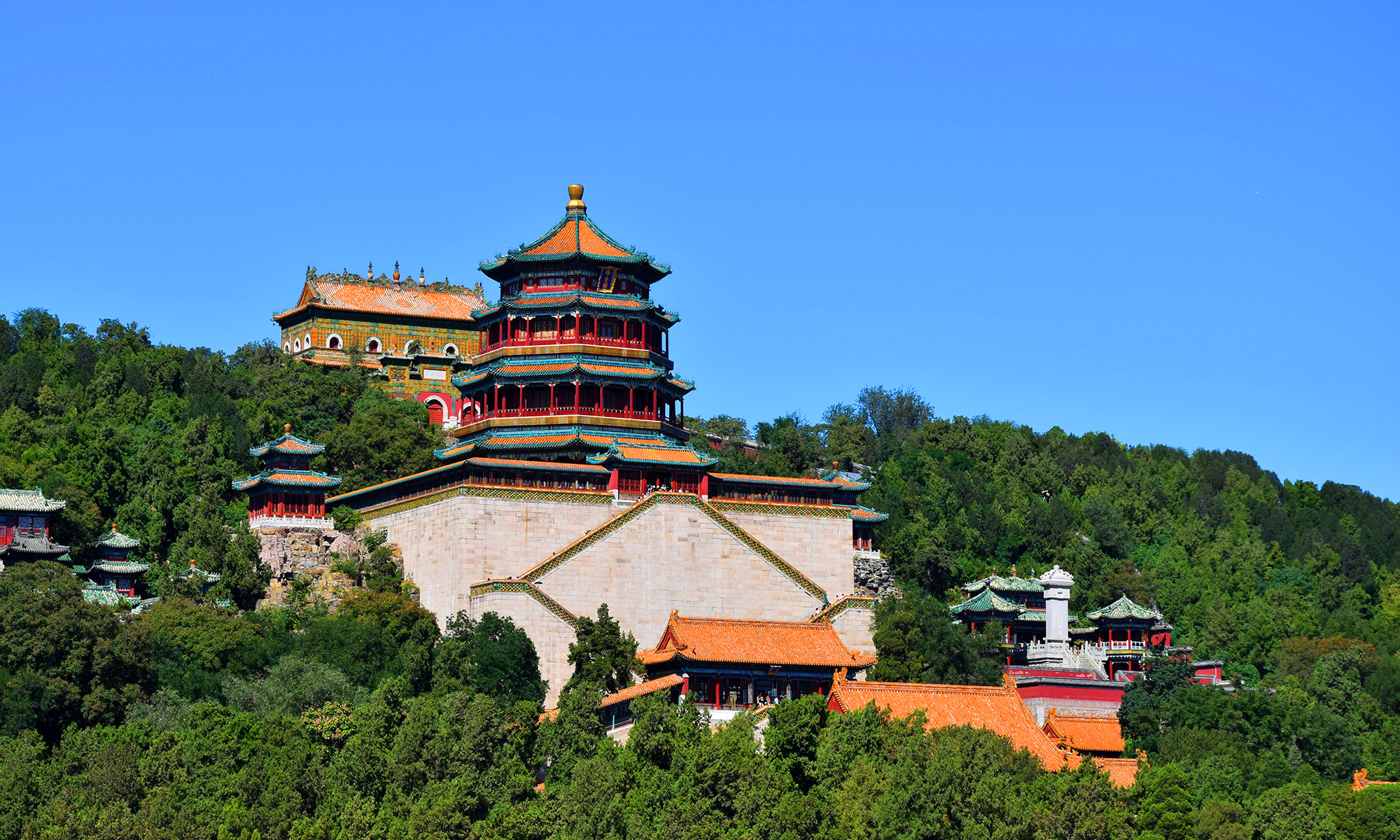
La zone avant de la Colline de la Longévité est la plus extravagante. Toute la zone pittoresque est reliée par deux axes symétriques. L'axe est-ouest est le célèbre long corridor; L'axe sud-nord commence au milieu du long corridor, featuring the Pai Yun Men (Gate of Clouds), Pai Yun Dian (Hall of Clouds), De Hui Dian (Hall of Benevolence and Glory) and the Fo Xiang Ge (Tower of Burning Buddhist Incense). The Fo Xiang Ge is the center of the park, with surrounding structures distributed symmetrically.
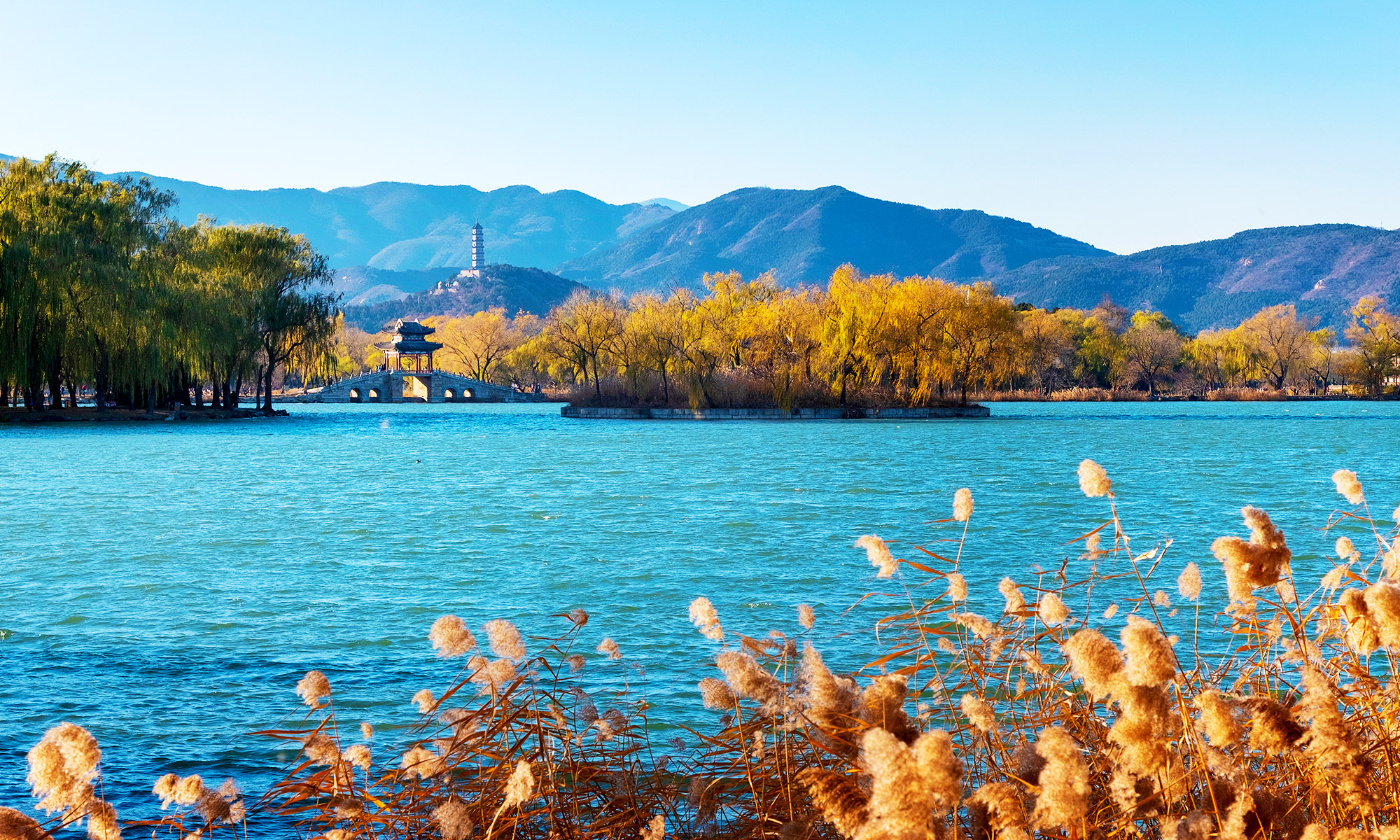
The northernmost is the behind-hill lake zone. Although there are not many structures, woods and trees grow luxuriously, with winding hill paths, presenting a sharp contrast to the extravagance of the hill front scenes. A group of Tibetan style structures and a scene typical of southern China form the compactly arranged Suzhou Street. The water surface of Kunming Lake accounts for three-fourth of the park. With its rippling water dotted with boats, the lake is the best place to view Longevity Hill, which is like a scroll of Paintings unfolding toward the east. In the lake, there is a dike, called Xi Di (Western Dike), which is lined with peach and willow trees and has six arched bridges of different types. There are also different types of ancient structures in the three islands on water. The 17-arch bridge lies across the lake, a scene that visitors never forget.
• Structures in Summer Palace
The Summer Palace is the best-kept imperial garden in Beijing. It boasts the best ancient structures as well as garden styles. It is virtually a museum of traditional Chinese gardens.
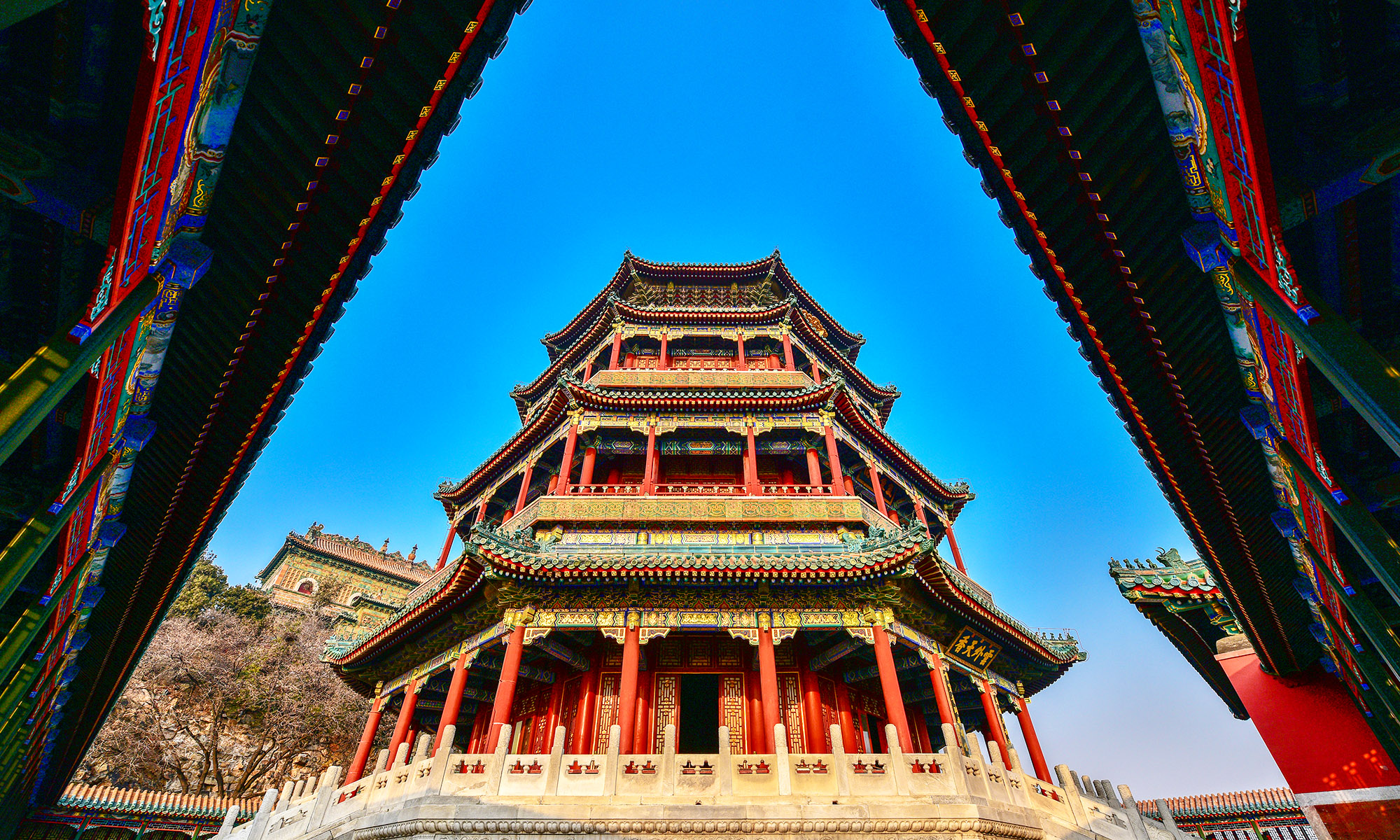
The main structure in the Summer Palace is the Fo Xiang Ge atop Longevity Hill. The tower is built on a square foundation 21 mètres de hauteur. It stands 40 meters high and has eight facades, three stories and four tiers of roofs. It represents the best of ancient Chinese architecture.
Verandahs and angled pavilions are featured in the gardens. The Long Corridor of the Summer Palace is about 728 meters long, the longest in the world. The painted beams bear more than 4,000 pictures about legendary stories or flowers, birds, fish and insects. On the eastern bank of KunmingLake is a double-eaved octagonal pavilion, the largest in China. De plus, there is the beamless hall on the top of the Longevity Hill, which is built entirely of all bricks and stones, without any prop.
The casting and carving are of the highest quality in the world. The big cast iron bull on the eastern bank of Kunming Lake is very vivid, with inscriptions on the back. On the northern bank is a marble boat, with the beams and props exquisitely carved.
The Summer Palace has amassed the best of ancient Chinese architectural styles. In the east, halls and houses form enclosed courtyards linked to one another by corridors, a style derived from the courtyard houses of North China. In the south, an embankment lined with willow cuts through the lake, an imitation of the scenic West Lake in Hangzhou. On the north slope of the Longevity Hill do structures resemble Tibetan lamaseries and a shop-lined street named after Suzhou.
How to get to Summer Palace
En métro
• Prenez la ligne de métro 4 to Beigongmen Station (Sortie C). Puis, walk west for 3 minutes to the North Palace Gate.
• Take Metro Line to Bagou Station. Then take Western Suburban Line to Yiheyuanximen Station.
• Take Metro Line or Line 16 to Xiyuan Station (Exit C2). Walk west for about 15 minutes to the East Palace Gate.
En Bus
• To the East Palace Gate: Prenez le bus n°. 303, 331, 332, 346, 508, 579, ou 584, and get off at Yiheyuan Station; or take bus No. 384, 394, 563, 594 ou 601 to Poshangcun Station.
• To the West Gate: Prenez le bus n°. 469 ou 539 and get off at Yiheyuan Ximen Station.
• To the North Palace Gate: Prenez le bus n°. 303, 331, 346, 394, 563, 584, 594 or Singtseeing Bus Line 3, and get off at Yiheyuan Beigongmen Station.
• To the New Palace Gate: Prenez le bus n°. 74, 374, ou 437, and get off at Xinjian Gongmen Station.
Additional travel advice on Summer Palace
• The though ticket includes entrance fee for the Palace and fees for Dehe Garden (¥5), Wenchang Temple (¥20), Foxiang Pavilion (15 ¥) and Suzhou Street (10 ¥).
• It is not advised to play on the surface of Kungming Lake in winter.